Kansas
In Cold BloodKansas in In Cold Blood is more than the setting of the Clutter murders: its open western plains, close-knit communities, investigative agencies, and legal system shape the crime’s consequences from the first shock in Holcomb to the final appeals. The state’s apparent spaciousness offers no protection from violence; after the killings, neighbors who had seldom needed to lock their doors begin to regard one another with suspicion.
Western Kansas and Holcomb
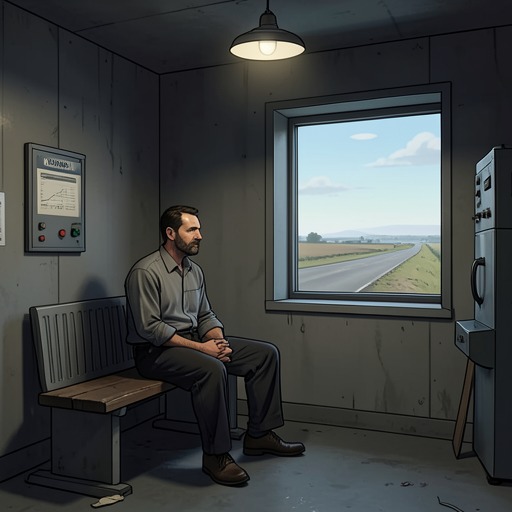
Holcomb lies on the high wheat plains of western Kansas, about seventy miles east of the Colorado border. The landscape is flat and far-reaching, under hard blue skies and clear, dry air. Horses, cattle, and grain elevators appear at a distance before a traveler reaches the town. The Santa Fe Railroad divides Holcomb through its center; the Arkansas River bounds it on the south, Route 50 on the north, and prairie and wheat fields extend to the east and west. Its streets are unpaved and unshaded, turning from dust to mud after rain or thaw.
The settlement itself is modest: a cluster of buildings, mostly one-story houses with porches. A former dance hall still bears its sign, although dancing has stopped and the sign has been dark for years. The Holcomb bank, closed in 1933, has become apartments; another apartment building, the Teacherage, houses many members of the school faculty. These visible signs of decline coexist with evidence of local prosperity. The consolidated Holcomb School serves kindergarten through senior high, and buses bring roughly 360 students from as far as sixteen miles away.
The town’s roughly 270 residents are part of a predominantly agricultural community with varied German, Irish, Norwegian, Mexican, and Japanese backgrounds. Farm ranchers raise cattle and sheep and grow wheat, milo, grass seed, and sugar beets. Rainfall averages only eighteen inches a year, and irrigation is difficult, making farming uncertain. Yet the seven years before the murders had brought favorable conditions. Prosperity came from agriculture and abundant natural gas, and could be seen in comfortable farmhouses, the new school, and the region’s large grain elevators.
The murders and the change in community life
Before the killings, Holcomb had been little known beyond Kansas. Its routines were work, hunting, television, school socials, choir practice, and 4-H meetings. The book sets this ordinary life against the violent event that makes the town nationally significant: four shotgun blasts in the early hours of a Sunday in November 1959 ended six lives. No one in the sleeping town heard them at the time. Their meaning arrived afterward, as residents repeatedly imagined the sounds and the community’s former ease gave way to mistrust.
The murders are set against the region’s openness and familiarity. Holcomb is neither a concealed urban labyrinth nor a remote settlement without institutions; it is a small town in a working, prosperous farming district, connected by road and rail to other Kansas communities. That contrast intensifies the change the crime brings. People who had felt sufficiently safe not to lock their doors begin to see old neighbors differently, as potential strangers. The landscape remains broad and exposed, but the sense of security that had accompanied ordinary life does not return simply because the town’s streets and fields remain unchanged.
Investigation and the reach of Kansas institutions
The Clutter case moves from local shock into a statewide investigation. The Kansas Bureau of Investigation, headquartered in Topeka, has nineteen experienced detectives available to assist local authorities when a case exceeds their capacity. Its Garden City representative, Alvin Adams Dewey, is selected to lead the investigation. His prior experience as a Finney County sheriff and as a Federal Bureau of Investigation special agent makes him a fitting choice; his friendship with Herbert and Bonnie Clutter also gives the case a personal weight. As the investigation develops, eighteen men are assigned full time, including Kansas Bureau of Investigation agents Harold Nye, Roy Church, and Clarence Duntz.
The state’s geography also links the crime’s western setting to places farther east. Olathe, a suburb of Kansas City, is about four hundred miles from Holcomb. That distance is part of the narrative’s movement between the perpetrators’ lives and the farming community they target: Kansas is not a single enclosed scene but a large territory crossed by roads, investigators, and the people under investigation. Garden City, near Holcomb, supplies a regional center for the case, while Topeka is the headquarters of the agency assisting it.
Kansas law, courts, and punishment
Kansas is also the arena for disputes about criminal responsibility and the limits of an insanity defense. In the case of Lowell Lee Andrews, whose defense relied on a diagnosis of schizophrenia, his lawyers and the Menninger Clinic sought to replace the M’Naghten Rule with the more permissive Durham Rule. The Kansas courts retained the M’Naghten standard, which turns on whether a defendant could distinguish right from wrong in the legal sense. The jury imposed the death penalty. The episode places the Clutter case within a wider Kansas debate about mental illness, responsibility, and punishment, without suggesting that the two cases are legally identical.
The state’s authority to prosecute and punish also appears in the account of George Ronald York and James Douglas Latham. Florida, Tennessee, Illinois, Kansas, and Colorado all sought the right to prosecute them; Kansas prevailed because it had the firmest evidence. Kansas used hanging as its method of execution, in contrast to the other states’ use of electrocution or lethal gas. This detail makes the state’s role more than territorial: its courts and penal system determine where a multistate case will be tried and how its sentences may be carried out.
The appeals in the Clutter case extend that legal process beyond Kansas. After the Kansas Supreme Court granted a stay of the first execution date, later lawyers challenged the convictions in federal courts. Their arguments included the timing of appointed counsel, the adequacy of representation at trial, evidence seized without a search warrant, and the refusal to move the trial despite extensive publicity. The Supreme Court of the United States declined three times to grant a full hearing. In March 1965, the Kansas Supreme Court set a final execution window for April 14; Governor William Avery denied clemency. Kansas thus frames the case at both ends: the crime ruptures a western community, and the state’s legal institutions ultimately decide the course and finality of its punishment.